Reducing a Fraction

Reducing fractions is standard procedure when solving math problems. It involves taking the GCF (Greatest Common Factor), and if none is found, there is NO reduction.


Steps to Take

  1. Take the GCF of the number values in the numerator and denominator.
  2. If none are found it can’t be reduced, but if one is found you proceed.
  3. Divide the top and bottom by the GCF.

Ex. What’s the following fraction reduced, if that’s possible?

\dfrac{9}{36}


9 \longrightarrow 3 * 3 \longrightarrow 3^{1} * 3^{1} \longrightarrow 3^{2}

36 \longrightarrow 9 * 4 \longrightarrow (3 * 3) * (2 * 2) \\ \longrightarrow 3^{1} * 3^{1} * 2^{1} * 2^{1} \longrightarrow 3^{2} * 2^{2}

GCF = 3^{2} = 9

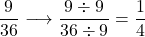
\dfrac{9}{36} \longrightarrow \dfrac{9 \div 9}{36 \div 9} = \dfrac{1}{4}


Comments

Leave a Reply

Your email address will not be published. Required fields are marked *