Category: Basic Math

  • Reducing a Fraction

    Reducing fractions is standard procedure when solving math problems. It involves taking the GCF (Greatest Common Factor), and if none is found, there is NO reduction.


    Steps to Take

    1. Take the GCF of the number values in the numerator and denominator.
    2. If none are found it can’t be reduced, but if one is found you proceed.
    3. Divide the top and bottom by the GCF.

    Ex. What’s the following fraction reduced, if that’s possible?

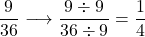
    \dfrac{9}{36}


    9 \longrightarrow 3 * 3 \longrightarrow 3^{1} * 3^{1} \longrightarrow 3^{2}

    36 \longrightarrow 9 * 4 \longrightarrow (3 * 3) * (2 * 2) \\ \longrightarrow 3^{1} * 3^{1} * 2^{1} * 2^{1} \longrightarrow 3^{2} * 2^{2}

    GCF = 3^{2} = 9

    \dfrac{9}{36} \longrightarrow \dfrac{9 \div 9}{36 \div 9} = \dfrac{1}{4}


  • Adding and/or Subtracting Fractions with Different Denominators

    It’s necessary to know the LCM (Least Common Multiple) in order to complete the steps of solving such fractions, unlike same denominator fractions.
     

    Steps to Solve

    1. List the values of the denominators.
    2. Find the LCM of them.
    3. Use algebra to find missing numbers that when multiplied to the denominator values, they yield the already found LCM.
    4. Make a remade equation that has separate fractions multiplied to it that are composed, top and bottom, of the found missing numbers which cause the denominators of the original fractions to equal the LCM.
    5. Now same denominator fractions are the new fractions where only the numerators are added and/or subtracted to get the final answer.

    Ex. What is the answer to the following problem?

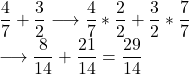
    \dfrac{4}{7} + \dfrac{3}{2}

    7 \longrightarrow 7^{1}

    2 \longrightarrow 2^{1}

    LCM: 7^{1} * 2^{1} = 14^{1} = 14

    7 * x = 14 \longrightarrow x = 2

    2 * x = 14 \longrightarrow x = 7

    \dfrac{4}{7} + \dfrac{3}{2} \longrightarrow \dfrac{4}{7} * \dfrac{2}{2} + \dfrac{3}{2} * \dfrac{7}{7} \\ \longrightarrow \dfrac{8}{14} + \dfrac{21}{14} = \dfrac{29}{14}


    Can it be reduced?

    \dfrac{29}{14}

    29 \longrightarrow 29^{1} \\ 14 \longrightarrow 2 * 14 \longrightarrow 2 * (2 * 7) \longrightarrow 2^{1} * 2^{1} * 7^{1}

    There is NO GCF, so no reduction.

  • Simplifying Radicals

    Radicals can often be simplified used The Largest Perfect Square. It’s considered right practice to reduce them.


    Steps in Simplifying Radicals

    1. Breakdown into multiples.
    2. Breakdown multiples into prime numbers.
    3. Express those prime numbers as powers.
    4. Multiply the same-base powers so to get the largest perfect square.
    5. Rewrite radical as the product of the largest perfect square and one of the other powers.
    6. Take the square root of the largest perfect square, express as number, and move it outside the radical – while leaving the other power – now expressed as a number.
    7. Multiply the number outside the radical to a non-zero coefficient, if there is one.


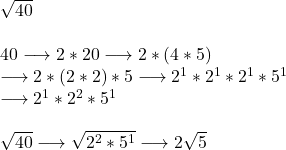
    What is the following radical when simplified, if it can be simplified?

    \sqrt{40} \\ \\  40 \longrightarrow 2 * 20 \longrightarrow 2 * (4 * 5) \\ \longrightarrow  2 * (2 * 2 ) * 5  \longrightarrow  2 ^{1} * 2^{1} * 2^{1} * 5^{1} \\ \longrightarrow 2^{1} *  2^{2} * 5^{1} \\ \\ \sqrt{40} \longrightarrow \sqrt{2^{2}* 5^{1}} \longrightarrow 2 \sqrt{5}


  • Finding the GCF (Greatest Common Factor) of Non-Zero Integers

    The GCF is the greatest positive integer that divides evenly into two or more non-zero integers

    It is vital in reducing fractions, a final step often needed after math calculations.


    How to Find It

    1. Break down each target number into multiples (If it is negative take the absolute value of it first) until there are only prime multiples.
    2. Express the values as powers.
    3. Multiply the same-base powers of each target number to get the highest value possible.
    4. Multiply the lowest  same-base powers that exist in both target numbers together.
    5. The product  is the GCF.


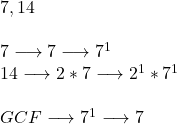
    What is the GCF of the following?

    7, 14 \\ \\  7 \longrightarrow 7 \longrightarrow 7^{1}\\14 \longrightarrow 2 * 7 \longrightarrow 2^{1} * 7^{1}\\ \\ GCF \longrightarrow 7^{1} \longrightarrow 7


  • Finding the LCM (Least Common Multiple) of Non-Zero Integers

    The LCM of Non-Zero Integers is the smallest positive integer that is a multiple of two or more given non-zero integers.

    It is vital to understand in order to add and/or subtract fractions with different denominators.


    Steps in Finding The LCM

    1. Break down the target numbers (If negative take absolute value first,) into multiples – until there are only prime factors.
    2. Express those factors as powers.
    3. Multiply the same-base powers from each target number until you get the highest power possible.
    4. Multiply together the highest same,-base powers.
    5. The LCM is the product.


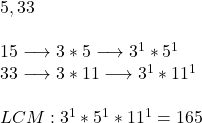
    What is the LCM of the following numbers?

    5, 33 \\ \\ 15 \longrightarrow 3 * 5  \longrightarrow 3^{1} * 5^{1} \\ 33 \longrightarrow 3 * 11 \longrightarrow  3^{1} * 11^{1}\\ \\ LCM: 3^{1} * 5^{1} * 11^{1} = 165


    Related Forum Problems:

    Finding The LCM of Non-Zero Integers