Skip to content

Good News .name

  • About
  • Forum
  • Math/Science Tutoring
  • Login / Register

  • Simplifying Radicals

    Radicals can often be simplified used The Largest Perfect Square. It’s considered right practice to reduce them.


    Steps in Simplifying Radicals

    1. Breakdown into multiples.
    2. Breakdown multiples into prime numbers.
    3. Express those prime numbers as powers.
    4. Multiply the same-base powers so to get the largest perfect square.
    5. Rewrite radical as the product of the largest perfect square and one of the other powers.
    6. Take the square root of the largest perfect square, express as number, and move it outside the radical – while leaving the other power – now expressed as a number.
    7. Multiply the number outside the radical to a non-zero coefficient, if there is one.


    What is the following radical when simplified, if it can be simplified?
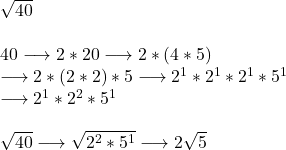
    \sqrt{40} \\ \\  40 \longrightarrow 2 * 20 \longrightarrow 2 * (4 * 5) \\ \longrightarrow  2 * (2 * 2 ) * 5  \longrightarrow  2 ^{1} * 2^{1} * 2^{1} * 5^{1} \\ \longrightarrow 2^{1} *  2^{2} * 5^{1} \\ \\ \sqrt{40} \longrightarrow \sqrt{2^{2}* 5^{1}} \longrightarrow 2 \sqrt{5}


    November 22, 2026
  • Finding the GCF (Greatest Common Factor) of Non-Zero Integers

    The GCF is the greatest positive integer that divides evenly into two or more non-zero integers

    It is vital in reducing fractions, a final step often needed after math calculations.


    How to Find It

    1. Break down each target number into multiples (If it is negative take the absolute value of it first) until there are only prime multiples.
    2. Express the values as powers.
    3. Multiply the same-base powers of each target number to get the highest value possible.
    4. Multiply the lowest  same-base powers that exist in both target numbers together.
    5. The product  is the GCF.


    What is the GCF of the following?

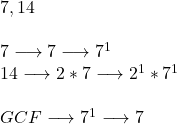
    7, 14 \\ \\  7 \longrightarrow 7 \longrightarrow 7^{1}\\14 \longrightarrow 2 * 7 \longrightarrow 2^{1} * 7^{1}\\ \\ GCF \longrightarrow 7^{1} \longrightarrow 7


    November 21, 2026
  • Finding the LCM (Least Common Multiple) of Non-Zero Integers

    The LCM of Non-Zero Integers is the smallest positive integer that is a multiple of two or more given non-zero integers.

    It is vital to understand in order to add and/or subtract fractions with different denominators.


    Steps in Finding The LCM

    1. Break down the target numbers (If negative take absolute value first,) into multiples – until there are only prime factors.
    2. Express those factors as powers.
    3. Multiply the same-base powers from each target number until you get the highest power possible.
    4. Multiply together the highest same,-base powers.
    5. The LCM is the product.


    What is the LCM of the following numbers?

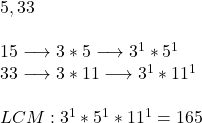
    5, 33 \\ \\ 15 \longrightarrow 3 * 5  \longrightarrow 3^{1} * 5^{1} \\ 33 \longrightarrow 3 * 11 \longrightarrow  3^{1} * 11^{1}\\ \\ LCM: 3^{1} * 5^{1} * 11^{1} = 165


    Related Forum Problems:

    Finding The LCM of Non-Zero Integers


    November 21, 2026
  • TSJ: Is the New Jerusalem in Salt Lake?

    November 16, 2026
  • TSJ: Protestant Pastors Predicting the Restoration

    November 16, 2026
  • ATIF: The Problem of Hell

    November 13, 2026
  • EI-R: What’s the Deal with LDS?

    November 11, 2026
  • JD: How You Know When to Stop Taking Psychiatric Medication

    November 9, 2026
  • TF: The Problem of Selective Divine Intervention

    November 9, 2026
  • EE: Did Joseph Smith Fail This Test?

    November 8, 2026
1 2 3 … 10
Next Page→

Good News .name

The Wholesome Life

  • About
  • Forum
  • Math/Science Tutoring
  • Login / Register

Twenty Twenty-Five

Designed with WordPress